7 SAT Prep Tips for Adults Returning to the Test in 2026
I walked into my first SAT practice test at 34 with a mechanical pencil that felt like a relic from a past life and a calculator I hadn't touched since college calculus. The proctor—a high schooler's mom—asked if I was there to pick someone up. I laughed nervously and took a seat in the back row. That afternoon, I scored 210 points higher than I had at 17, not because I'd gotten smarter, but because I finally understood how to study like an adult: strategically, efficiently, and without the panic of a teenager who thinks one test decides their life. If you're returning to the SAT in 2026, here's exactly what I learned—and what you need to do differently.
Why the SAT Feels Different the Second (or Third) Time Around — and Why That's Your Hidden Advantage
Let's be honest: sitting down to retake the SAT as an adult feels weird. The test hasn't changed that much in content, but you have. You've got a job, maybe kids, definitely less free time, and a brain that's been marinating in spreadsheets, emails, and real-world problem-solving instead of quadratic equations and vocabulary drills. That can feel like a disadvantage. It's not.
Adults bring something most 17-year-olds lack: context. You know why time management matters because you've missed deadlines at work. You understand that one bad section doesn't ruin your life because you've recovered from bigger setbacks. And you've built the discipline to stick with a plan—even a boring one. The trick is to stop trying to study like a teenager and start building a prep system that fits the person you are now.
I've coached a handful of adult test-takers over the years, and the ones who succeed don't cram. They audit, prioritize, and simulate. Below are the seven tips that consistently work for the adults I've worked with—and for me personally.
7 SAT Prep Tips for Adults Returning to the Test in 2026
Tip 1: Audit Your Old Score Report — It's a Goldmine of Weak Spots
Before you open a single practice book, dig up your old SAT score report. If you don't have it, take a free official practice test from the College Board and get a diagnostic breakdown. Don't just look at the total score—examine the subscores: which math domains did you bomb? Which reading passage types took you longest? For me, it was always the science-adjacent passages and anything involving systems of equations. Knowing that saved me about 40 hours of random review. I spent two weeks drilling exactly those weak spots and skipped the rest. Your score report is a map; don't wander without it.
Tip 2: Build a Calendar That Respects Your Real Life (Not a High Schooler's Schedule)
When I first started prepping, I tried to block out two-hour study sessions every evening. That lasted three days. Real life—dinner, a work email that couldn't wait, sheer exhaustion—kept getting in the way. Here's what actually worked: I split my study into 30- to 45-minute chunks, three to four times a week, and I scheduled them like meetings. Tuesday morning before work? 30 minutes of math drills. Thursday during my lunch break? One reading passage with timer. Saturday morning? A full practice test. This rhythm felt sustainable for 12 weeks. A sample week for a working adult might look like:
- Monday: 30 min math review (weak areas only)
- Wednesday: 45 min reading strategy (two-pass method, see Tip 5)
- Friday: 30 min grammar/writing rules
- Saturday: Full timed practice test (3 hours)
- Sunday: Review mistakes and update weak-spot list (20 min)
The key is consistency over intensity. One 30-minute session that actually happens beats a two-hour session you skip because you're too tired.
Tip 3: Relearn the Math You Actually Forgot — Skip the Rest
I'm going to be blunt: you do not need to re-learn all of high school math. The SAT tests a fairly narrow set of topics—algebra, problem-solving and data analysis, some geometry, and a tiny bit of trig. The stuff that most adults forget is algebra (solving for x in weird fractions, systems of equations) and coordinate geometry (slopes, intercepts). I spent two weeks re-teaching myself how to graph a line and solve a system in two variables. That alone raised my math score by 80 points. What I didn't do: spend time on complex numbers, matrices, or advanced geometry. Those rarely appear, and when they do, you can guess strategically. Use a diagnostic test to identify your three weakest math domains, then drill those exclusively. Efficiency, not comprehensiveness, is your friend.
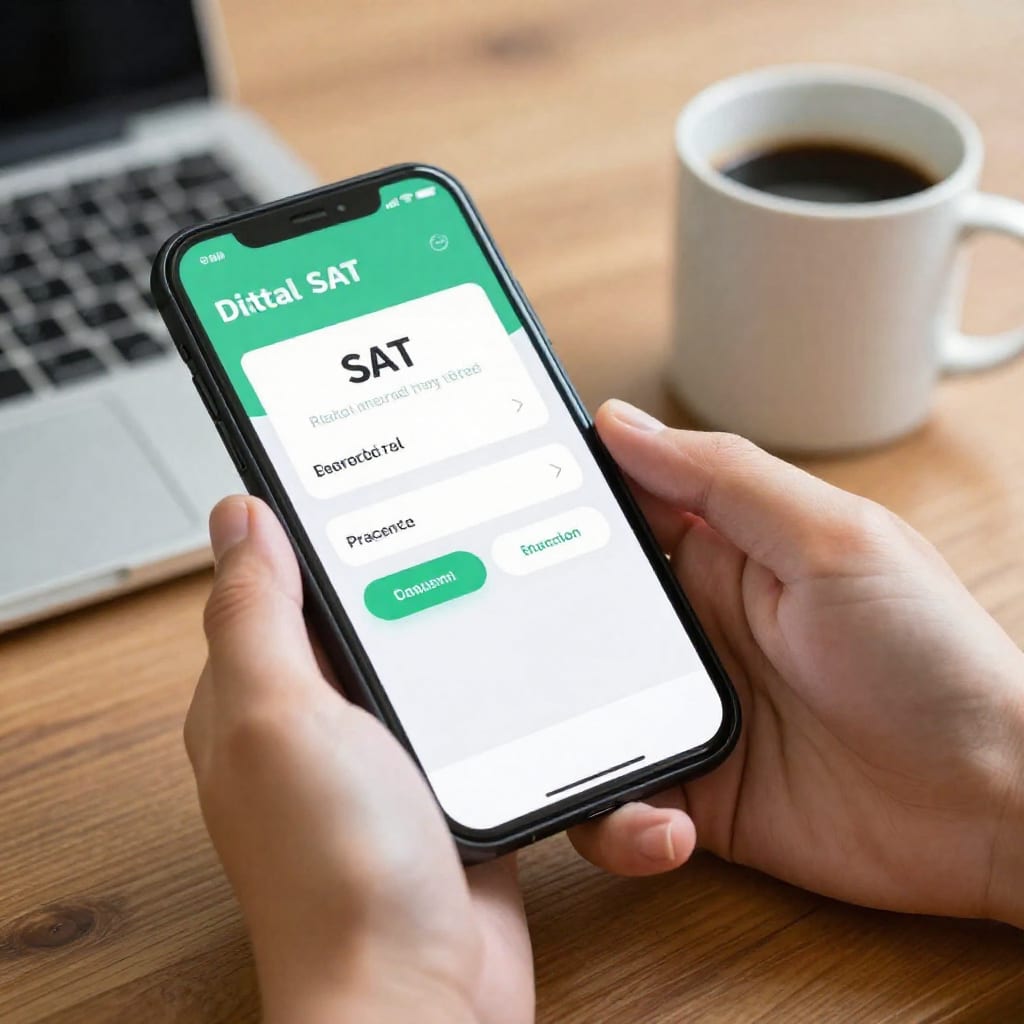
Tip 4: Master Digital SAT Format Changes Before Test Day
The SAT went fully digital in the U.S. in 2024, and by 2026, the format is well-established but still catches adults off guard. Key changes: the test is shorter (about 2 hours 14 minutes), each section is adaptive (your performance on the first module determines the difficulty of the second), and there's a built-in graphing calculator for the entire math section. For adults, this is actually good news. You're likely comfortable with digital tools already. But you need to practice on the official Bluebook app—not on paper. I made the mistake of doing my first practice test on a printed PDF and then floundered on test day because the interface felt different. The app has a timer, a flagging system for questions you want to revisit, and a note-taking tool. Practice with it until the navigation feels automatic. Also, note: you can take the test at home with remote proctoring or at a test center. I chose a quiet test center because my home Wi-Fi is unreliable. Know your tech limits and plan accordingly.
Tip 5: Use the “Two-Pass” Strategy for Reading Passages
Adult readers tend to read carefully and slowly—a strength in real life, a liability on a timed test. The two-pass strategy fixes that. Here's how it works:
- Pass 1 (skim, 2 minutes): Read the passage title, first sentence of each paragraph, and any bolded terms. Get a general sense of the topic, structure, and main argument. Don't take notes yet.
- Pass 2 (targeted, 8 minutes): Go to the questions. For each question, identify the relevant part of the passage (the question stem often tells you which paragraph or line to look at) and read only that section carefully. Answer based on the text, not your outside knowledge.
I tested this against my natural read-every-word approach: the two-pass method cut my reading section time by 25% and improved my accuracy because I wasn't getting bogged down in details I didn't need. Try it on three practice passages before test day to make it feel natural.
Tip 6: Treat Practice Tests Like Dress Rehearsals — Simulate the Real Thing
Nothing replaces full-length practice tests under real conditions. I did six full practice tests over 12 weeks, each one timed, with no phone, no snacks except during the official break, and no pausing. I even wore the same clothes I planned to wear on test day (comfortable but not pajama-level). The first one was brutal—I ran out of time on the math section. By the fifth, I knew exactly how to pace myself and when to guess and move on. Official College Board practice tests are non-negotiable here; third-party tests often have slightly different difficulty curves. Treat each practice test as data, not as a score to stress over. After each one, I spent 30 minutes reviewing every mistake and adding it to my weak-spot list. That review time is where the real learning happens.
Tip 7: Manage Test-Day Nerves With a Mental Script and a Physical Routine
Adults carry a different kind of pressure: you've invested time and money, you might be taking time off work, and you've told people you're doing this. The stakes feel heavier. I dealt with this by building a pre-test routine that started the night before. I packed my bag (ID, water, approved calculator, snack, charger), set two alarms, and had a simple dinner—grilled chicken, rice, vegetables, nothing spicy or heavy. Morning of: same breakfast I'd eaten before every practice test (oatmeal and a banana). I arrived at the test center 30 minutes early, sat in my car, and ran through a mental script I'd written: “I have prepared. I will focus on one question at a time. If I get stuck, I'll flag it and move on. This is a tool, not a verdict on my worth.” Sounds cheesy, but it worked. My heart rate stayed steady, and I didn't panic when the first math module felt hard. Find your own script and test it during a practice test. Physical routine plus mental rehearsal cuts test-day adrenaline spikes significantly.

How to Choose the Right SAT Prep Resources for Your Adult Brain
Not all prep materials are created equal for adult learners. You don't need a 500-page book full of fluff exercises. You need resources that focus on strategy, conceptual understanding, and efficient practice. Here's my shortlist:
- College Board's Official SAT Practice on Khan Academy: Free, aligned to the actual test, and adaptive. It identifies your weak areas and gives you targeted practice. This is your primary resource.
- The Official Digital SAT Study Guide (Bluebook app): The only practice tests that mirror the real interface. Use these exclusively for full-length simulations.
- 1600.io (paid option): Offers deep video explanations for every official practice test question. Great for the moments when you don't understand why a correct answer is correct.
- Pivot to concept books (like Erica Meltzer's grammar guides) only if you need to rebuild fundamentals in a specific area.
Avoid anything that promises “secrets” or “shortcuts.” The real shortcut is consistent, targeted practice with official materials.
Common Pitfalls Adults Face When Retaking the SAT — and How to Sidestep Them
Overconfidence is the biggest trap. I've seen adults assume that because they've been successful in their careers, the SAT will be easy. It's not—it's a specific skill set that requires practice. Another common mistake: underestimating the time commitment. I've had friends sign up for the test, study for two weeks, and then wonder why their score barely moved. Plan for 8-12 weeks of consistent work. Finally, don't neglect the essay section if your target schools require it (check first—many don't). If you need the essay, practice writing under timed conditions at least three times. The structure is formulaic, and you can master it with repetition.
Here's a quick checklist to stay on track:
- [ ] Take a diagnostic test and identify weak spots (Week 1)
- [ ] Build a weekly calendar with 3-4 shorter sessions + 1 full test
- [ ] Drill weak math and grammar topics (Weeks 2-4)
- [ ] Practice two-pass reading strategy (Weeks 3-6)
- [ ] Take full practice tests every 2 weeks (Weeks 2-12)
- [ ] Review every mistake and update weak-spot list
- [ ] Final week: light review, mental script, and logistics check
Frequently Asked Questions About SAT Prep for Adults
Is it harder to raise your SAT score as an adult?
Not necessarily. Adults often have better focus and discipline, but may need to relearn specific math concepts. Consistent, targeted practice can yield significant gains.
Are there SAT fee waivers or discounts for adults?
College Board offers fee waivers for low-income students, but they are typically for high school juniors/seniors. Adults may not qualify, but check with the testing center or your employer for reimbursement options.
How long should an adult study for the SAT?
A realistic minimum is 8-12 weeks of 2-3 hours per week, but this varies by starting score and target. Use a diagnostic test to gauge your baseline.
Should I take the SAT online or at a test center as an adult?
The digital SAT is now the only format in the U.S., and you can choose between home testing (with proctoring software) or a test center. Adults often prefer home testing for comfort, but ensure your tech setup meets requirements.
Do colleges care about my age when they see my SAT score?
Colleges evaluate the score in context, but age itself is not a factor. A strong score demonstrates readiness regardless of when you graduated high school.
One last thought: returning to the SAT as an adult isn't about proving you're still smart. It's about proving you can still learn. And that's a muscle that gets stronger every time you use it. Bring your patience, your calendar, and your willingness to focus on what actually matters—and you'll walk out of that test center feeling like you finally showed up for yourself.